Outshift by Ciscodesign

Outshift Design

Designing the Frontier

What it takes to build for the edge of the known.

This is a field guide to how Outshift Design explores what's next, and how you can bring that practice into your own work.

Most design answers a demand
that already exists.

The frontier is the opposite problem. You design before the demand exists, with no brief, no proof, and no customer who can describe a future they have not lived.

Established design
  • The demand already exists
  • There is a brief and a known problem
  • You improve what people can already describe
The frontier
  • The demand does not exist yet
  • No brief, no proof, no map
  • You build toward a question and learn

We are not just designing what comes next.
We are learning what next could be.

Our focus is where...

Needs are forming.

People feel the friction before they can name the future they need.

Possibilities are moving.

The question shifts from "what can it do?" to "what should it make possible?"

The value is unproven.

We have to learn what matters, for whom, and under what conditions.

We design the frontier.

Here's how we explore it, build on it, and learn our way across it, so you can do the same.

A frontier is where conditions converge.

No single signal tells us what to build. The work is to form a useful hypothesis from the intersection of a technology shift, a business ambition, and a human context.

01 / TECHNOLOGY SHIFT A new capability appears What might now be possible? 02 / BUSINESS AMBITION A future worth pursuing What change could matter? 03 / HUMAN CONTEXT Needs and meaning form Who could value the change? THE FRONTIER Value is unproven THE DESIGN CHALLENGE What future should we make possible and test?

Start from three beliefs.

The future is built, not predicted

You do not forecast the frontier. You make a piece of it real enough to react to.

Aim at a question, not a demo

Frame the belief that, if it is wrong, ends the idea, before you build. The artifact's only job is to earn a yes or a no.

Trust the cheap signal, not the expensive opinion

Put rough work in front of people whose reaction you trust, early, before the budget makes you need it to be true.

Research beyond
the present.

Today's needs matter. But customers cannot describe a future they have not experienced. So research has to understand the wider space, form a hypothesis about what could matter, and make that possibility real enough to explore.

Move through ambiguity to confident bets
on what comes next.

Our six step process is how we get there, turning emerging signals into hypotheses we can test and act on.

Step 1 Frame the Thesis

We begin by defining the phenomenon worth exploring, rather than presuming a product or feature.

Example

How might AI agents change how people coordinate complex work in a world where agents can act across multiple tools and services?

DeliverableResearch brief + short intent statementResearch brief (scope, goals, assumptions) · A short intent statement: “This inquiry explores… in order to inform design decisions about… in tomorrow’s world.”

Step 2 Map the Emerging Edge

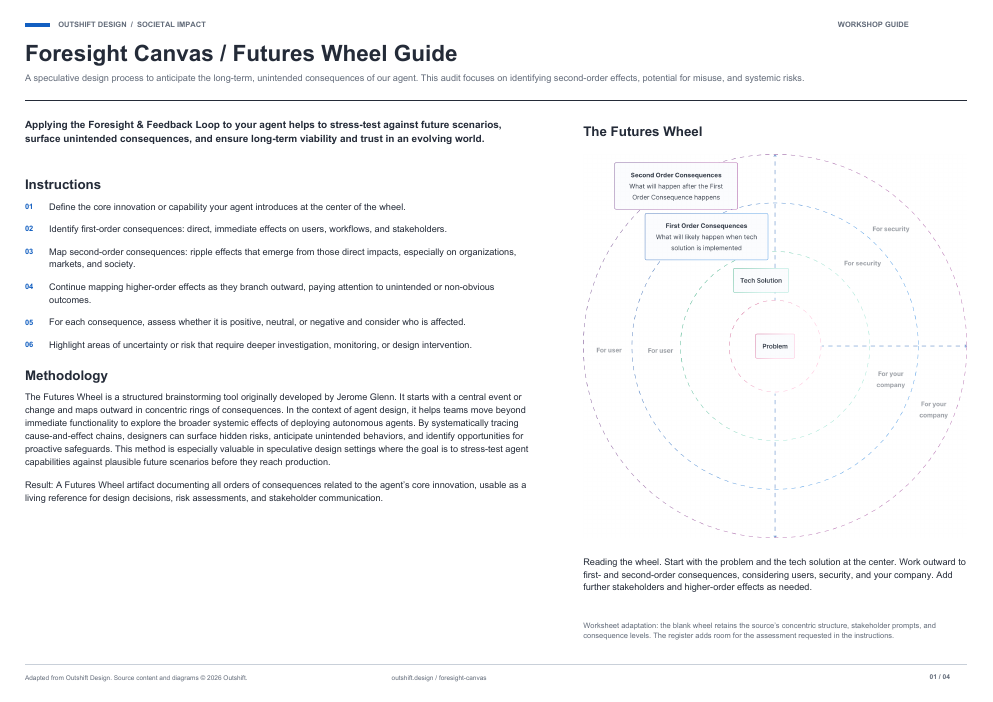
We don’t map today’s pains. We scan for the weak signals and emerging shifts already in motion, then project where they could lead.

Example

Trace the trajectory of AI agents acting across tools and services: not how people coordinate work today, but the new behaviors, dependencies, and risks that emerge as agents take on more.

DeliverableSignal map + early trajectoriesWeak signals and emerging shifts, each projected forward: if this holds, what second-order consequences follow, and for whom?
Foresight Canvas template previewSteal the templateForesight Canvas

Step 3 Make Sense of Patterns

We seek to understand the tensions between current needs and emerging possibilities.

Example

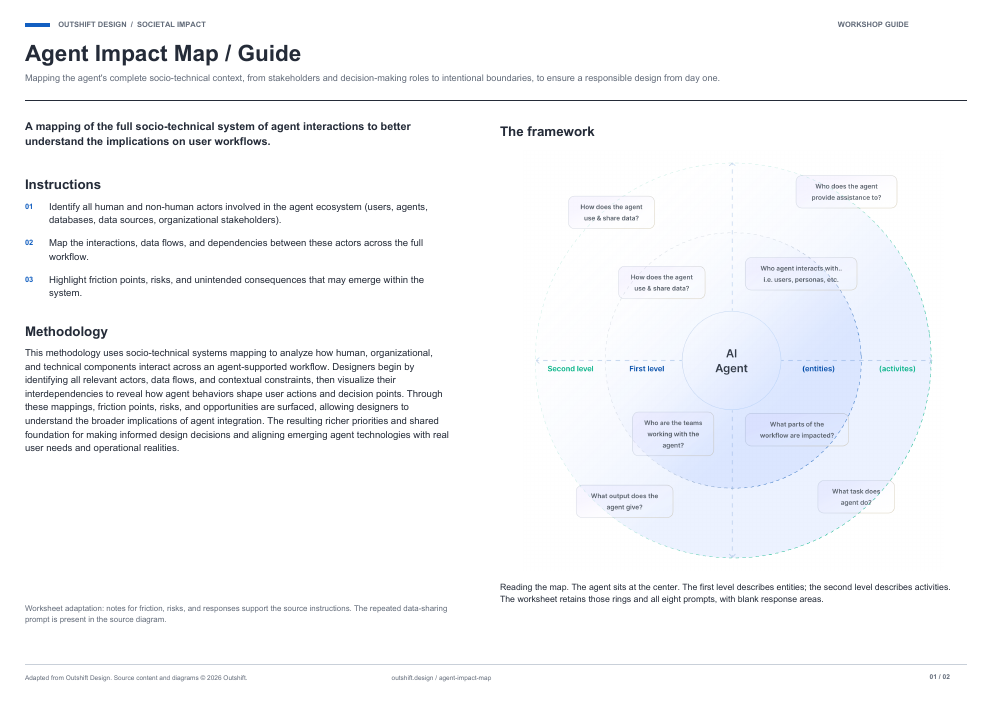
Identify tensions between how people coordinate work today and how AI agents could reshape that in a world where agents act across tools and services.

DeliverableInsight statements + Opportunity areas“People don’t yet trust AI agents to coordinate complex work; they rely on their own checks.”
Agent Impact Map template previewSteal the templateAgent Impact Map

Step 4 Translate Insights into Design Intents and Speculative Worlds

We explore how a design intent could shape first and second-order consequences.

Example

How might we help people see what an AI agent is doing, understand why, and redirect it while it coordinates work across tools?

DeliverableHMW set + prioritization grid + design principlesFor example: “Never hide cause,” “Always let me override.”

Step 5 Prototype Behavior First, Not the UI

We test how people and systems respond to one another before shaping the interface.

Example

Prototype the agent’s behavior in a short scenario and observe how a person responds before designing the interface.

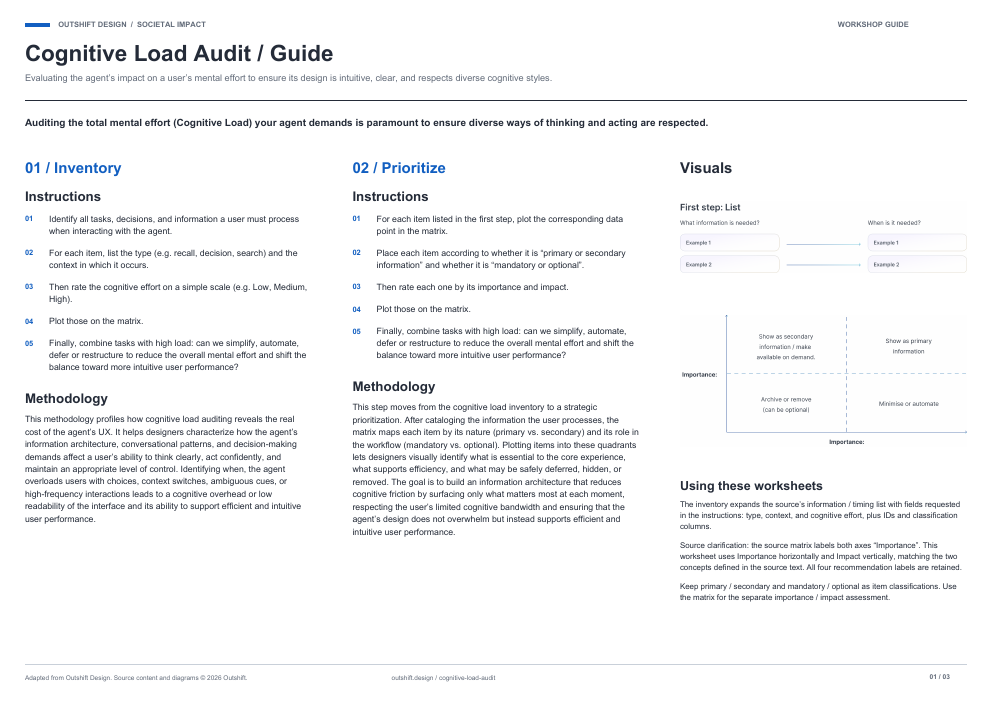
Key questionDoes the interaction change the user’s behavior or feelings as predicted in Step 4?
DeliverableSecond Order Consequence Mapping
Cognitive Load Audit template previewSteal the templateCognitive Load Audit

Step 6 Bridge Futures Back to the Present

We translate speculative insights into present-day opportunities, constraints, and design levers.

Example

Backcast from a future where AI agents coordinate complex work across tools and services: what can we do today to prepare people to work with them?

DeliverableBridging matrix (Future → Today)Columns: Scenario → Risks → Opportunities → Present-day design levers.

Build your way through
the unknown.

Four moves turn an emerging possibility into something people can examine, challenge, and learn from.

Sense. Frame. Make. Learn.

Read the space

Notice the shift, ambition, and human context that could change what is possible.

a signal
Make a future bet

State what could become possible, who may value it, and what must be true.

a hypothesis

Make it discussable

Give the bet a form people can experience before it is fully built.

a probe

Learn with people

Explore it with specialists. Notice what matters, what changes the bet.

a next move
Repeat the loop, each pass sharper than the last

Tools for working without a map.

Each tool supports a different part of the process.

FTHM

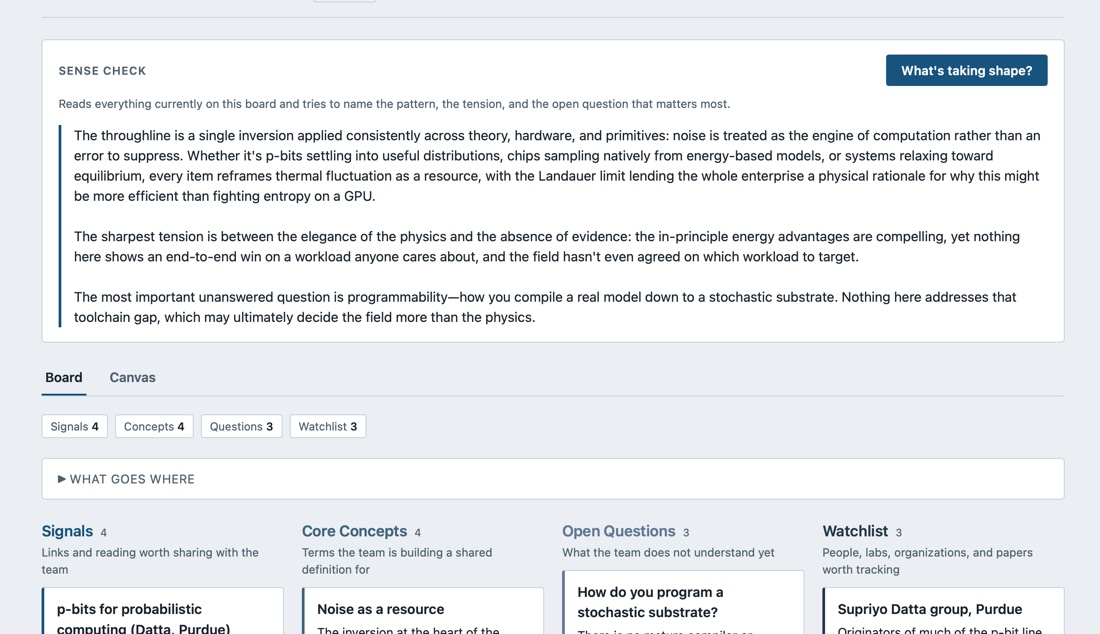
A shared board, private canvases, and AI that names the tension.

Sense and frameMake different interpretations and tensions visible.

TOME

Evidence, research, and prior decisions in one grounded conversation.

Carry contextKeep evidence and decisions in play across the work.

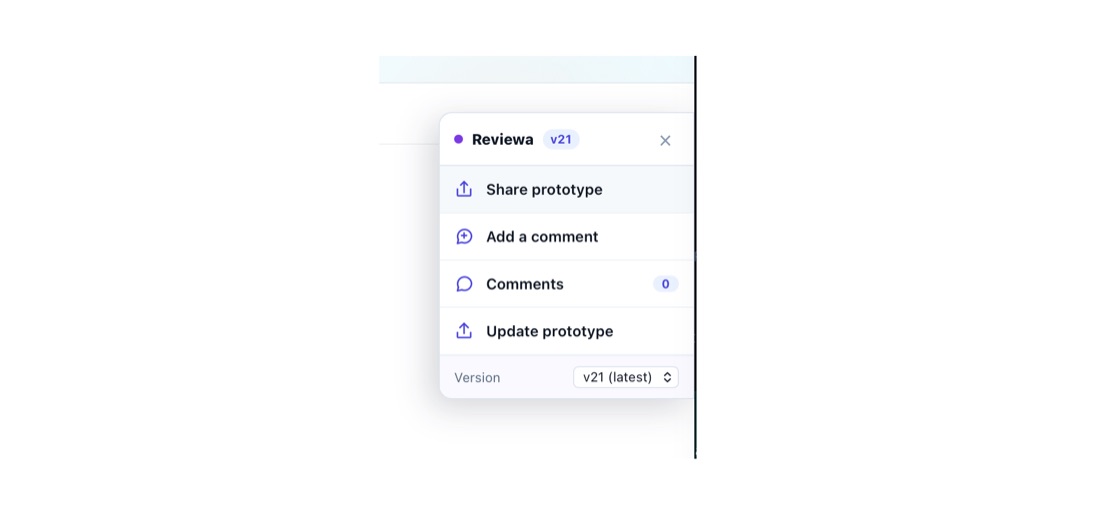
Reviewa

Make a concept visible and turn reactions into the next design question.

Get signalPut a rough concept in front of people and learn from reactions.

Now, a case study.

See the four moves work on a real frontier question: an illustrative quantum networking probe that helps an operator explore a path before anyone relies on it.

What if an operator could explore a quantum path before relying on it?

INTENTDescribe the serviceWhat must the network make possible?
FITExplore a pathCould quantum add value here?
SIMULATEMake behavior visibleWhat might happen under these conditions?
EVIDENCESee the limitsWhat can the operator trust or question?

A probe makes the behavior discussable. It does not claim a working quantum network: fidelity drops across each swap, the end to end estimate lands near the operator's trust threshold, and the weak hop becomes a concrete question a specialist can confirm or challenge. Figures would be illustrative.

An operator walks a quantum path, then watches how it behaves.

Inside the probe / explore and simulate
Illustrative
A quantum network path from New York to London through two repeaters, with per-hop entanglement fidelity and a simulated end-to-end readout EXPLORE THE PATH F 0.95 F 0.90 F 0.88 New YorkService endpoint RepeaterEntanglement swap RepeaterEntanglement swap LondonService endpoint SIMULATE → EVIDENCE What the operator can inspect, trust, or question END-TO-END FIDELITY 0.81 operator trust threshold 0.80 EST. DELIVERY SUCCESS 72% over a 12 pairs/s entanglement rate A LIMIT WORTH QUESTIONING Hop 2 fidelity sits just above the trust threshold. A specialist can ask: is one swap enough, or does this path need another repeater before a service relies on it?
The probe does not claim a working quantum network. It makes the behavior discussable: fidelity drops across each entanglement swap, an end-to-end estimate lands near the operator's trust threshold, and the weak hop becomes a concrete question the specialist can confirm or challenge. Fidelity and rate figures are illustrative.

Now it's your turn.

You have seen the four moves work on a real frontier question. Here is how to run the same practice on your own.

Take it to your frontier.

When you spot a shift worth exploring but the problem is not defined yet, run this. Solo to sharpen a premise, or with a team to make competing reads visible.

You'll create...

  • A signal worth chasing
  • A future bet, written down
  • A probe people can react to
  • A learning question
  • One next decision
Sense Frame Make Learn
SenseWhat's shifting, and who should you listen to?

Make the unknown tangible.

Run the four moves in 45 minutes. Solo to sharpen a premise, or with a team to make competing interpretations visible and decide what to learn next.

0 min45 minutes, one next decision45 min
13
8
15
9
Sense · 13 min

Read the space

Map a technology shift, business ambition, and human context, and the questions they raise together.

Frame · 8 min

Make a future bet

Describe what could become possible, for whom, and what must be true.

Make · 15 min

Build a probe

Sketch one scenario or service moment that lets someone encounter the possibility.

Learn · 9 min

Choose the signal

Look for evidence that would make you keep, change, or drop the hypothesis.

Steal the toolkit.

Three tools we built for working without a map. Use each at the move where it helps most.

FTHMSense & Frame

Open a shared board, give everyone a private canvas, and let an AI layer name the tension so the team can inspect and correct it.

Steal the repo
TOMECarry the context

Keep evidence, research, and past decisions in one grounded conversation, so what you have learned travels with the work.

See how we built it
ReviewaMake & Learn

Put a concept in front of people and turn their reactions into your next design question.

Steal the repo

Make the method yours.
Build what you need.

The practice is yours to adapt. Three starting points to make sense of an emerging opportunity, build your own sensemaking space, and explore it with your team.

Build pattern / FTHM

A space that thinks with your team

A shared board, private canvases, and an AI layer that names a possible tension for people to inspect and correct.

Field card / run with a team

A 45 minute frontier session

Four moves, timed prompts, and the artifacts to leave with: a signal, a bet, a probe, and a learning question.

Research guide / start from the future

Research the space, not the request

Read changing conditions, ground a future hypothesis, and use tangible concepts to learn with people.

Designing the Frontier · Outshift Design

Now, go build
what comes next.

The unknown gets smaller when we make it visible, testable, and shared.

Scroll or ← → · N notes · F fullscreen
1 / 1

On this slide

No notes.

FTHM / early sensemaking

A buildable sensemaking space.

When people enter an emerging topic with different assumptions, a meeting can push the group to agree before it understands what is in tension.

The frontier problem

Difference is useful data.

Early in a space, people may be reacting to different signals and imagining different futures. FTHM makes those starting points visible before the group settles on one frame.

The build

Three connected surfaces.

  • A shared board collects signals, concepts, open questions, and a watchlist.
  • Private canvases let each person connect ideas in their own way.
  • An AI sense-check names a pattern, tension, or question for the group to inspect.
Try the method

Let people think separately before synthesizing together.

Invite each person to make a private map of what seems possible and what feels unresolved. Bring the maps into the shared space. Ask the group to inspect the tension the AI surfaced, correct it, and decide what they need to learn next.

InputSignals and different interpretationsShared artifactA tension the group can discussNext moveOne open question or watch item
FTHM · shared board · product view
Visual placeholder
Drop in: a screen capture of the FTHM board: the shared signal columns, a private canvas, and the AI sense-check panel naming the tension.
A closer look
01

Post the signals

Everyone adds what they are seeing to the shared board: shifts, concepts, open questions, and a watchlist.

02

Think on your own canvas

Each person maps what seems possible and what feels unresolved before the group converges on one frame.

03

Inspect the tension

AI names a pattern or tension across the inputs. The group corrects it and decides what to learn next.

Field note concept / FTHM interaction details shown here are illustrative
TOME / context as design material

Give the next idea somewhere grounded to begin.

In frontier work, the team keeps learning as the space changes. Useful context can be spread across research, strategy, customer evidence, and prior decisions.

The frontier problem

What the team learned can disappear.

New explorations often restart from a blank page, repeat settled questions, or inherit a conclusion without its evidence.

The build

Make context usable in the work.

Frame TOME as a place where research, strategy, decisions, and source material can be brought into the same conversation, so teams can find what is known and where the gaps remain.

Try the method

Carry the evidence forward, including what is still uncertain.

Before starting a new concept, bring forward the most relevant evidence and decisions. Keep the source attached. Separate what the team observed from what it inferred. Mark contradictions and unknowns so the next exploration can challenge them instead of quietly treating them as facts.

KeepEvidence with its sourceDistinguishObservation from interpretationExposeGaps, contradictions, and assumptions
TOME · shared context · product view
Visual placeholder
Drop in: a TOME view where evidence, research, and decisions sit in one place, with sources kept and open gaps marked.
A closer look
01

Bring sources together

Pull the most relevant evidence, research, and prior decisions into one conversation, each with its source attached.

02

Separate observed from inferred

Mark what the team actually saw apart from what it concluded, so later work can tell evidence from assumption.

03

Expose the gaps

Flag contradictions and unknowns so the next exploration can challenge them instead of treating them as settled.

Field note concept / TOME story framing for this guide
Reviewa / ideas made tangible

Turn a concept into a conversation.

A future can be hard to discuss as an abstract statement. A prototype gives people something concrete to react to while the team can still change direction.

The frontier problem

Approval is not evidence.

People can agree with a pitch without seeing how the idea changes their choices, work, or confidence. Feedback needs a specific thing to respond to.

The build

Make the rough idea reviewable.

Use a prototype to show a possible future. Invite focused reactions while it is still inexpensive to change. Treat each reaction as a clue about the premise, not a vote on the finished product.

Try the method

Watch what changes when someone experiences the idea.

Give a participant a realistic situation and let them move through the concept. Ask what they believe is happening, what they would do next, and what feels missing. Record where they hesitate, what they trust, and what they reinterpret. Bring those signals back to the premise before polishing the prototype.

Set upA scenario, not a feature tourNoticeInterpretation, hesitation, and actionDecideKeep, change, or test the premise
Reviewa · pinned feedback · product view
Visual placeholder
Drop in: a Reviewa capture where comments pin to the exact element of a prototype, scoped to the screen they were left on.
A closer look
01

Share one link

Publish the prototype and send a single link. No build to install, no setup for the person reacting.

02

Pins anchor to the element

Each comment attaches to the exact element it is about, scoped per screen, so feedback stays where it belongs.

03

Reactions become the next question

Hesitations and reinterpretations collect as signal, then feed straight back into the premise and the next build.

Field note concept / Reviewa story framing for this guide
04 / Case study · the four moves

How each move shows up in this probe.

The same four moves that shape any frontier bet, traced through the quantum networking example.

01 / SENSE

Read the space

Notice the technology shift, business ambition, and human context that could change what is possible.

A signalQuantum networking may enable future services that conventional network paths cannot support.
02 / FRAME

Make a future bet

State what could become possible, who may value it, and what must be true.

A hypothesisMake quantum a practical capability for future services. Teams need a way to see where it could add value.
03 / MAKE

Make it discussable

Give the hypothesis a form people can experience before the solution is fully built.

A probeIntent → Fit → Simulate → Evidence. An illustrative future-network interaction, not a live product.
04 / LEARN

Learn with people

Explore it with relevant specialists. Notice what matters, what is missing, and what changes the bet.

A next moveWhat decision does this support? What evidence builds trust? When would another path be better?
Illustrative concept only. Not a Cisco commitment, roadmap, or research finding.